Making Education Fun Ruins Both Education and Fun
A few years ago, a series of cookbooks were marketed to harried mothers that promised to get children to eat vegetables. Every recipe offers the same approach: disguise them as something more appealing–say, a cupcake or chicken nugget. Less sophisticated strategies may involve serving acorn squash covered in brown sugar.
Does it work? It seems that any amount of squash the kid consumes is a victory. Meanwhile, the kid gets suspiciously good at scraping sugar off of squash. Experienced parents know the depths of desperation that drive a person to cover vegetables in sugar.
There is an analogous phenomenon in education, whereby less palatable tasks are either made to resemble something else or covered in the experiential equivalent of sugar. Many parents homeschooling their children know this dynamic well. While learning should and often does bring joy, it does not always have to in order to be useful or good. Artificially changing how something is taught simply to make it more palatable to students is like covering vegetables in sugar, and it often has the paradoxical effect of ruining both learning and fun.
Sugar-coated Education
These days, making learning “fun” is a lucrative and ever-expanding cottage industry. Do you want your child to learn about World War II? There are dozens of cartoons that will provide a nonstop stream of sarcasm, puerile jokes, and glib commentary about it. Do you want your child to learn math? There are games for phones and tablets designed to focus attention on filling a colorful bar on a screen or achieving a score to trigger a pleasant ding. What about science? If you are willing to pay a high-priced monthly subscription, there are boxes with curated, hands-on science projects, whose accompanying informational booklets you may promptly discard because your child will not read them.
You think, “My child will learn everything he is supposed to. And more importantly, he will never be bored.” That, at least, is what these things promise.
In his 1985 book Amusing Ourselves to Death, Neil Postman warned of the threat posed by the rise of children’s “educational” shows, such as Sesame Street, and of our increasing reliance on such palatable fare in lieu of more traditional methods. Postman did not think there was anything inherently wrong with television for entertainment. But treating these shows as a substitute for education, he argued, was misguided. When a child is shown an “educational” television program (or, we may say in 2024, a game on a phone), it does not make him “love learning.” Instead, it teaches him to tolerate learning only if it resembles entertainment. “We now know,” Postman wrote, “that Sesame Street encourages children to love school only if school is like Sesame Street.”¹
By today’s standards, the passage is quaint. Sesame Street does not seem so bad or alluring as the significantly more appealing–and often highly addictive–media to which children now have access. But Postman’s point is also eerily prescient. We seem to have decided, collectively, that the best way to make children eat their vegetables is to serve them under a thick layer of sugar. We fail to recognize that the child who is given such a meal does not thereby learn to love vegetables. Instead, he learns to demand that every meal taste like dessert.
Sugar-coating education consists of two problems: (1) it teaches that learning is best when least painful and (2) it fails to teach very much.
First Problem: Making Learning “Fun” Teaches the Wrong Lesson
The purpose of education is not simply to impart knowledge. It is to develop character. When students receive a proper education, they do not just learn about the world and their place in it. They learn the necessity of delayed gratification for success and freedom from vice.
Delayed gratification is one of the four cardinal virtues. In tradition, it is classically called temperance. By Aquinas’ definition, “temperance withdraws man from things which seduce the appetite from obeying reason, while fortitude incites him to endure or withstand those things on account of which he forsakes the good of reason.”² Temperance is our inner guardian against the tyranny of the appetite, and fortitude hardens us against its power.
These virtues enable us to learn best precisely because the best things are not learned easily. According to Postman, educators have long understood that “learning to be critical and to think conceptually and rigorously do not come easily to the young but are hard-fought victories.”³ Learning is often frustrating and uncomfortable. No matter how enthusiastically one starts out, there will be times when one’s excitement wanes and attention begins to wander. When this happens, students must be able to sustain their efforts and ignore the enticements of other, easier activities.
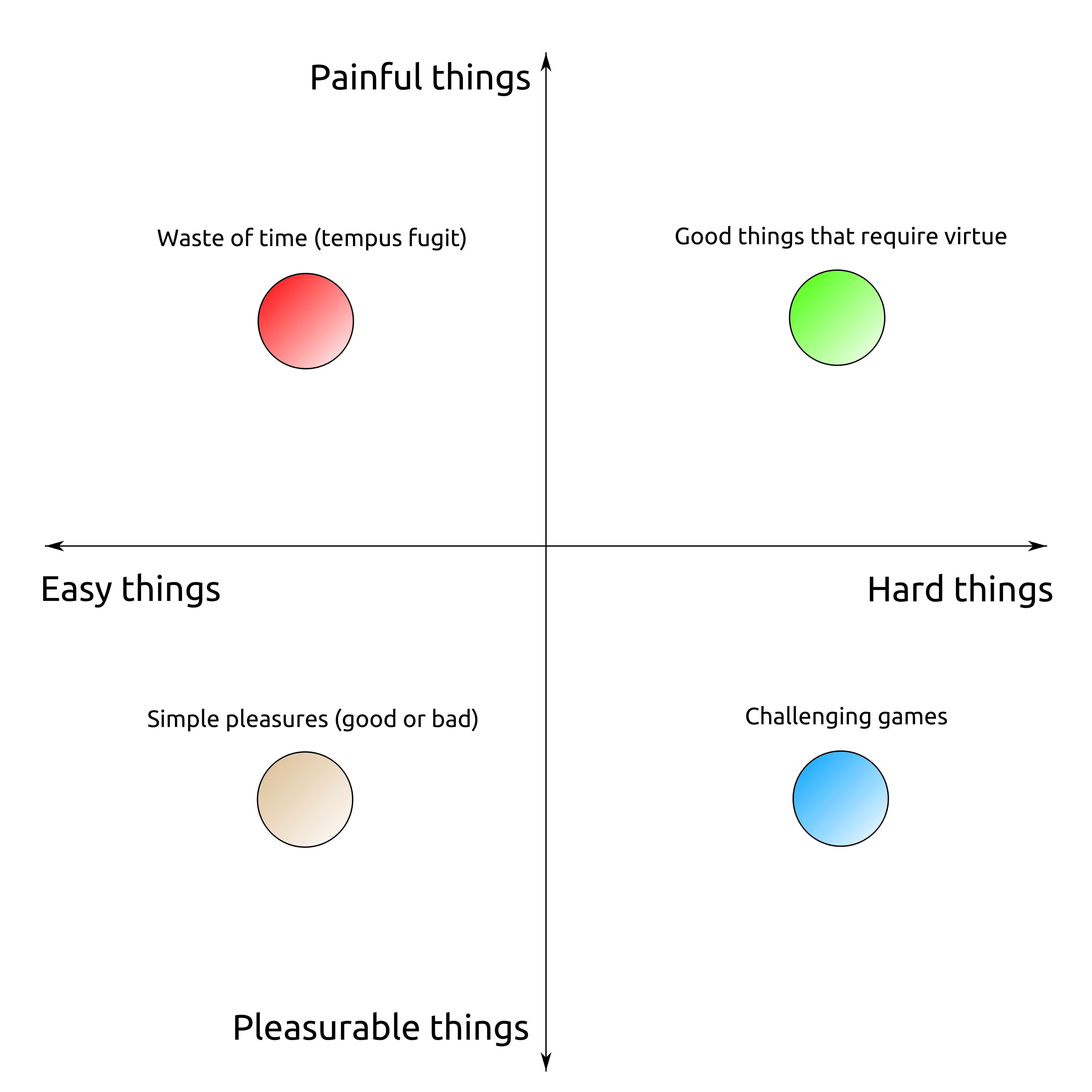
If this is true of an adult pursuing a difficult, but rewarding, goal–say, learning Latin or reading War and Peace–then it applies even more so to children. Consider a first-grader learning to read or ride a bike. There will be times when he would rather be doing something else. The screen beckons, but it offers only comfort and demands little but our attention.
Parents and teachers must make a decision: either remove the challenge or help the child master the skills needed to overcome it. If we choose the latter, our children learn how to delay gratification: to put aside current feelings of discomfort or boredom in order to achieve something worthwhile. We could choose the former. We could say to the child, “You are right. The squash tastes bad. Here–have this nice bowl of sugar instead.” But then we short-circuit the learning process. Rather than nurture self-discipline, we deprive the child of overcoming the difficulty and fail to teach him that he should try.
One may object, however, that making education “fun” and pleasurable does, in fact, teach skills. The problem is that even if it does so, it teaches children to love learning only if it is pleasurable. Sed omnia praeclara tam difficilia quam rara sunt.⁴ (But all excellent things are as difficult as they are rare.)
This does not mean that we should gleefully pile arduous tasks upon our children, not just because it would be senseless, but because learning happens at the edge of our capabilities. A task that is too easy imparts nothing, while one that is too difficult causes us to disengage. In psychology, the set of tasks between these extremes are said to be in our zone of proximal development. It is on the horizon of our abilities–where we are challenged, even if pained–that we actualize our potential.
The child who is challenged and learns to overcome that challenge comes away with a precious gift: the knowledge that it is within him to do so. But the child who is deprived of this may learn that if something does not interest him right away, or is not easy, it is not worth doing. He is taught that everything in life can–and should–be coated in sugar.
But not everything will or should be. This brings us to the second problem.
Second Problem: “Fun” Educational Activities Do Not Teach Much
Those who follow the brown sugar squash analogy may raise an obvious objection: “Well, it got him to eat the squash. So what if we had to add a little sugar?”
This is where the analogy falls apart. Learning is really not the same as begrudgingly eating one’s least favorite vegetable. Learning is cumulative and sequential: it requires a carefully-laid foundation on which things of greater complexity can be built. E. D. Hirsch, a 20th-century educational theorist, writes that “the ability to learn something new depends on an ability to accommodate the new thing to the already known.”⁵ We learn by analogies, whose understanding depends on relevant background information.
What happens when a child encounters something–say, an entertaining video about the Apollo Space Program–without relevant background information? What will he actually learn? He may glean, from the splashy visuals and dramatic voice-over, that something momentous took place. But there will be many things that escapes his notice or understanding: the development of the V-2 rocket, the cultural changes in post-War America, the underlying tension of the Cold War. People, places, and events mentioned will enter his consciousness and exit just as quickly.
Certainly, some things may stick. Some facts, for example, may be vividly and even fondly remembered. But facts are not understanding. Understanding requires assimilating facts into a conceptual and linguistic network in one’s mind through active engagement and participation with the facts. Without sufficient background knowledge already understood, the child will soon forget most of the facts he is told precisely because he is unable to explain them or their significance.
We understand this on an intuitive level. How many of us were forced to read a book in high school that made little or no impression on us–only to return to it as an adult and find it rich and meaningful? “I got more out of it as an adult,” we say. Yes, but why? Is our reading comprehension that much better? In one sense, yes–but not for the reason one might think. The difference is greater background knowledge relevant to the subject.
As adults, we are armed with a vast array of facts. Who was Icarus? What is a carpetbagger? What was the Manhattan project? What do we mean by deus ex machina? We may not be experts about any of these things, but we do not need to be. Our familiarity with them is enough to banish the shadows that previously obscured our understanding.
We could certainly look up facts, but unless we have a treasury of knowledge committed to long-term memory, our short-term memories are soon overloaded with the novel information required to solve complex problems. Complex problem solving simply requires a basis of prior knowledge. The less we know, the less easily we can make sense of problems. The more we know, the more easily we can make sense of them. Ask any expert in any field.
Our children do not have such a treasury of knowledge. “Educational” videos, “science experiment” boxes, and “hands-on” museum exhibits do not teach them nearly as much as we think they do. Why? Because they lack the relevant prior knowledge needed to assimilate new knowledge through analogy. Kids, in turn, treat them as diversions–and only mildly entertaining ones at that. This is the other unfortunate truth about “fun” educational activities: they not only fail to educate, but also to be fun. They satisfy no one: neither the serious student, who is eager to learn and to take on a challenge, nor the child who only wants to be entertained. A simple game that makes no pretense of having educational value will always be more alluring to the latter.
This is not to say that one should never engage in education-infused fun. Museums, historic battlefields, or applying chemistry and fractions to baking–all of these bring an extra level of satisfaction to a child’s education. The problem is not in taking a child to a museum so that he may marvel, in horrified fascination, at the bone saw a Civil War-era surgeon would have used to amputate a limb. It is in thinking that this kind of fun can replace learning itself.
Education through “fun” activities and games trivializes important ideas and neuters their gravity. Imagine taking seriously the deeply emotional and human nuances of the Divine Comedy through a game that scores your progress. It is difficult to take the most important lessons of Stoicism seriously if they are presented in a milieu of gimmicks and noise providing a simulacrum of accomplishment and ersatz satisfaction.
When one is surrounded on all sides by curated activity kits and interactive videos, it can feel a little uninspiring to pull out a book and read to your child. But these things, no matter how enticing, make promises they cannot keep. “Learning is cumulative, and at first it is slow.”⁶ When Ptolemy asked Euclid for a shorter way to his proofs, he replied, “There is no royal road to geometry.”
We cannot remove the challenges of learning without also vitiating its fruits. We should celebrate the challenge of raising our children to develop self-discipline and the cardinal virtues. Education is nothing if it fails to impart them.
- Neil Postman, Amusing Ourselves to Death (Penguin Random House, 1985), 143.
- Aquinas, Summa Theologica, Part II. Question 141. Article 2.
- Postman, 146.
- Spinoza, Ethics, Book V. Prop. 42. Sch. 1.
- E. D. Hirsch, Jr. The Schools We Need And Why We Don’t Have Them (New York: Anchor Books, 1996), 23.
- Ibid., 225.